Tuesday, June 7, 2011

Meet the crew

The 2011 UWF Pensacola Colonial Frontiers field school is truly a team effort, and today's post highlights our crew, with photos accompanying brief bios, all written by the students and staff themselves, in alphabetical order.
-----------------------------------


Colin Bean: "I am a second year graduate student at UWF. I am interested in British colonial archaeology and Geographic Information Systems (GIS). I have been doing archaeology since the summer of 2007."


Sarah Bennett will enter UWF's graduate program this Fall to pursue an MA in Historical Archaeology. She is interested in Colonial archaeology of Northeast Florida and public archaeology. Sarah also enjoys the beach, reading, movies, and being outdoors.


Katie Brewer: "I graduated in 2010 with my B.S. in Anthropology and History from Portland State University in Oregon. I am currently using both areas to pursue my Master's in Historical Archaeology. This field school is a learning opportunity to help me in my goal of a career in archaeology."


Marie Burrows is an undergraduate studying Historical Archaeology and working to support herself and her husband and two year old daughter. She hopes to stay in the area and find CRM work so that her daughter can be raised close to both sets of grandparents.


Lindsey Cochran is a graduate student at the University of West Florida studying terrestrial historical archaeology. Her primary academic interests include plantation studies and British colonial archaeology.


Danielle Dadiego: "I am a second year graduate student at the University of West Florida studying historical archaeology. My main interests include paleography, working with Spanish and ecclesiastical Latin historical documents and colonial trade systems."


Ashley Geisel: "I am a senior undergrad at UWF with a double major in archaeology and history with a minor in European studies. I want to go on to specialize in medieval and early Britain doing some sort of public archaeology."


Jonathan Harpster: "I'm an army brat, born in Germany to an army serviceman, I've wanted to do Archaeology since I was around 3 and first saw Raiders of the Lost Ark. Even though archaeology is nothing like Tomb Raider or Indiana Jones I'm still more than happy to do it, and enjoy spending time in the field or even the lab simply because I like to stop and think about what these items were used for and what history is behind them."


Norma Harris is a Research Associate at the UWF Archaeology Institute, specializing in Native American and Spanish colonial projects. She has been doing archaeology in Florida and Georgia for more than 20 years.


Ralph Hosch, Jr. is a native of St. Bernard Parish in Louisiana who received his BA in Anthropology from Tulane University at the ripe old age of 36. His subfield of interest is in Biological Anthropology, but his heart belongs to Archaeology. Ralph’s sons, Landon and Zachary, are upset we still haven’t found a golden idol, but are relieved that Ralph hasn’t been chased by a giant bolder yet (thanks Indy)!


Alesia Hoyle: "I am studying Archaeology and Studio Art at the University of West Florida. I have wanted to an archaeologist since the 6th grade and have always loved creating art. The world is beautiful in its state of constant growth and deterioration, and I desire to bring this to light in my work as a dirt lover and artist."


John Hueffed graduated with a BA from the University of South Alabama. He is interested in classical archaeology.


Phillip Mayhair: "I am a undergraduate Archaeology major at UWF. I grew up locally and graduated from Northview High School in 2008. I have a strong interest in Pensacola's history, especially the colonial colonial era, and I work at Historic Pensacola Village."


Patty McMahon is a graduate student in the Historical Archaeology program at UWF. Her primary academic interests are contact period archaeology, public archaeology, and preservation, and her secondary interests include pretty much everything else.


Rachael Mead is an Anthropology and Classics senior at the University of Florida, but a Pensacola native. She joined the field school this year to learn more about the history of Pensacola and get field experience in archaeology. She is interested in classical history and ancient languages and plans to pursue a graduate degree in Classical Archaeology.


Michelle Pigott is a new UWF graduate student studying historical archaeology. She is originally from Orlando and is excited to be living in a new city with such a deep and complex history. When she's not thinking about how awesome Florida archaeology is, Michelle likes to sew, read or play video games.


Nick Simpson: "I'm a senior, majoring in archaeology and I would like to get a master's in bioarchaeology from University of Colorado at Boulder. I like to spend my free time climbing, skating, skim boarding and slack lining. I also have every album from every band Slash has ever been in."


Joseph Stevenson is a undergraduate Sophomore at the University of Miami. He is perusing majors in Anthropology and Marine Affairs. After that he plans to go on to graduate school.


Brady Swilley: "I am an archaeology major interested in the medieval period of the Middle East. I am also a very devoted Christian."


John Worth is Assistant Professor of historical archaeology in the UWF Department of Anthropology. Since his first archaeological field school 30 years ago, he has specialized in the impact of European colonization on the Southeastern Indians. In addition to archaeology, he conducts archival research on colonial Spanish documents.

Monday, June 6, 2011

Following leads

Despite high heat and humidity over the past few days, as well as a rainstorm last Friday which required bailing the units this morning, student crews are making solid progress in a number of excavation units, pushing downward in an effort to discover subsurface trenches and pits which will help us understand the layout and configuration of Mission Escambe's structures. One unit which may overlap a north-south trending wall trench filled with yellow clay produced a surprise in the form of an ash and charcoal-filled feature adjacent to the clay (above is Phillip Mayhair bisecting the feature). This feature may be the remains of a large (though shallow) burned post, or it may be a hearth or smudge pit, or something else entirely.

The long wall trench we have been following since 2009 seems to be coming to an end to the east, where there is as-yet no evidence of the trench continuing into our easternmost testpit. Careful exposure of the trench from the last unit it appeared in should allow us to delineate the probable corner, and will guide us in additional testing to determine the exact shape and size of what we presume to be the Spanish barracks (to right is Ralph Hosch excavating the feature eastward toward its likely terminus in the unit at the top of the picture).

To the west, a larger testpit opened south of the presumed western end of this wall trench has yet to encounter any evidence of the structure's western wall, so we will likely have to turn our attention northward to see if the corner discovered last year is the southwest corner instead of the northwest, as we had initially interpreted. With each bit of negative evidence, however, we narrow down our search for the clues to this large but maddeningly elusive colonial building.

Adjacent to this trench, a large (apparently) circular pit feature is carefully being excavated by levels into its dark, mottled fill (to left is Nick Simpson scraping the soil matrix around the feature on the left side of the unit). The pit seems to be getting narrower with depth, but it still dwarfs all other pits and postholes yet discovered at the site, so we are increasingly intrigued to learn its function. A large glass necklace bead was discovered in the matrix of this unit today (photo at bottom), probably providing further evidence of the Indian trade at this mission village.

To the south, we have also just opened a pair of units constituting a long slot trench we hope will expose the cross-section of as many as four mission-era wall trenches found just to the east in previous years. Unfortunately, this trench also falls between several fast-growing sweetgum trees, and the interwoven roots of these trees comprise a formidable barrier to the kind of slow, careful excavation we intend to conduct (photo to right). With the roots nearly all gone, we anticipate beginning to see evidence for mission-era structures soon.

Step by step, our 2011 summer field school team is following the leads that will provide at least some of the answers we seek at Mission Escambe this year.


Above, a large clear glass necklace bead, wire-wound and faceted, dating to ca. 1700-1800 and possibly made in Amsterdam but common on period Spanish colonial sites.

Wednesday, June 1, 2011

The return of the heat

With temperatures approaching 100 degrees today, students still continue to make progress in excavations at Mission Escambe. The brick-filled trench discovered last year has finally (and reluctantly) begun to yield up more definitive clues as to its age. Following careful excavation, photography, and the creation of a detailed scale map (pictured to left, drawn by Alesia Hoyle and Rachel Mead), the bricks are gradually being removed and cleaned in the field in order to determine whether any maker's marks are present which might help pin down a date for the feature. Finally, today, a large part of a brick appeared within the feature showing a portion of the familiar "J. GONZALEZ" name present on many of the bricks from the nearby late 19th-century sawmill's ruins (pictured below). This makes it very likely that the entire brick feature post-dates the 1830s (when the bricks began to be produced). We still have to confirm whether the deeper portion of the trench, with double rows of parallel nails marking some sort of wooden structure underneath, is also a 19th-century feature, or perhaps originally constructed during the mission period.

We are also continuing to trace the wall-trench structure we believe to be the cavalry barracks, though as yet we still have no unequivocal confirmation of either the west or east walls of the structure. Nevertheless, we have opened a new excavation unit over another pit feature that showed up in a corner of one of our 2010 units, just south of the wall trench, and this pit is now quite clearly defined as a rounded pit perhaps a meter in diameter (photo to right). With continued work we hope to discover whether this pit relates to some architectural feature or some other activity such as simple trash disposal. At another end of this wall trench, a large and partially-charred bone from a deer was uncovered (pictured below), providing additional evidence for foodways (and the deerskin trade) at the site.

We have also been pleased to welcome students from two other summer field schools in the past few days, including the UWF Forensic Anthropology Field School led by Dr. Joanne Curtin, as well as the UWF Campus Field School, led by Dr. Ramie Gougeon. Pictures from these visits, as well as other shots from the past few days, are shown below.


Above, Patty McMahon shows ongoing work to members of the UWF Forensic Anthropology Field School.


Students from the UWF Campus Field School listening to Colin Bean explaining current excavation strategies at the presumed barracks structure.


Patty McMahon photographs the profile of a bisected feature.


Two mendable sherds of Guadalajara Polychrome, a colonial Mexican ceramic type dating to the 18th century.

Thursday, May 26, 2011

Rain and more finds

Today we experienced our first rain of the field season at Molino, and packed in early. Nevertheless, the last couple of days have been productive in terms of progress toward our goal of defining the structures and activity areas at Mission Escambe. We are better defining the area encompassed by the gray clay floor (?) in the southern end of the site, and at the same time encountering what may be further evidence for earlier wall trenches filled with yellow clay (to left are Phillip Mayhair documenting a shovel test shaded by Danielle Dadiego, with Norma Harris to the right). We are also closing in on a possible corner of the presumed barracks structure that now extends for nearly 17 meters across the site, as well as another potential wall line and other features in this area. Students are also following another possible mission-era wall trench in the northern margin of the site (perhaps an Apalachee structure), while simultaneously discovering further evidence of prehistoric occupation at the site. Below are photos of some of the students at work, as well as some of our most recent finds providing further clues about past activities in various areas of the site.


Above, Ralph Hosch and Nick Simpson shovel-scrape the floor of an excavation unit.


Colin Bean keeps up with his field notebook, recording every detail about ongoing fieldwork in his area.


Rachael Mead and Alesia Hoyle carefully draw a scale map of the brick-lined trench feature.


A rimsherd of Puebla Blue on White majolica.


A sherd of Apalachee pottery, classified as Lamar Incised, variety Ocmulgee Fields.


A prehistoric check-stamped rimsherd, possibly Gulf Check Stamped, associated with the Santa Rosa-Swift Creek culture dating nearly 2 millenia ago.


Remnants of a handful of copper-alloy rivets discovered in one excavation unit, one of which has a molded star decoration on the head (the rest are plain). The function of these objects, and when they were made (during or after the mission period), is not yet known with certainty (suggestions are welcome!).

Tuesday, May 24, 2011

Great weather, steady progress

As we enter our second week of the 2011 field season, the weather continues to be clear, dry, and not too hot or humid (yet), and all our student teams are making great progress toward answering some of our most pressing questions about Mission Escambe. Each new excavation unit opened answers some questions, but normally raises others, and after two summers of fieldwork at the site, we have lots of questions!

Several excavation units have been opened along the known or expected track of Feature 10, a substantial post-on-sill wall trench we believe may be part of the 1760 cavalry barracks built at the mission. We have now confirmed that the trench extends for at least 15 meters from the corner we discovered last year (above, see Danielle Dadiego and Colin Bean studying the plan view of the trench, located in the left side of the open unit), and a new testpit is currently being excavated to the east to determine whether it continues in that direction. Another excavation unit has been opened due south of the corner discovered last year, and there are preliminary signs that we may be coming down on the western wall of the barracks structure in this unit as well. The military barracks located in San Miguel de Panzacola at the same time (1760s) were no shorter than about 17.5 meters, and housed substantially more soldiers, so we anticipate finding another corner very soon.

In another area, students are excavating along the course of a brick-filled trench discovered last year to the north of the barracks (to right are John Hueffed and Rachael Mead excavating on either side of the exposed bricks). So far, all the bricks in this trench appear to be handmade and distinct from those found in nearby sawmill ruins known to date to the late 19th century, but as yet we are uncertain as to the date of this feature. Analysis of last year's excavations suggest the trench may include fragments of 19th-century bricks, but we hope to clarify this situation in 2011.

To the south, shallow shovel tests have been opened in the area of a widespread gray clay layer that was identified last year capping yellow clay fill within post-in-trench wall trenches from no fewer than three overlapping mission-era structures. We have already discovered what appears to be the eastern limit of this gray layer (left are Phillip Mayhair and Michelle Pigott mapping two of these tests), but units to the north still show evidence of the clay, and southern and western tests have yet to be started. The soil in this area is very dry (as it is across the rest of the site), making it a challenging task to probe this layer and discern color changes while excavating.

Among the more common residential debris from the mission site such as Apalachee Indian pottery fragments, rusted nails, etc., students discovered the drawn white tubular glass bead below, as well as a well-preserved large wrought iron nail or spike (unrusted where fire must have tempered the iron), and a lead musketball (approximately 59 caliber; clipped by the shovel), all shown below:


Tubular glass bead.


Large wrought iron nail, partially unrusted.


Lead musketball, approximately 15 mm. in diameter.

Thursday, May 19, 2011

We're back...2011 field season begins!

The 2011 University of West Florida Colonial Frontiers field school is now underway, and we're pleased to inaugurate a new series of entries to our annual project blog. With a team of 14 students enrolled in the undergraduate section, 3 graduate student supervisors, and graduate student field director Danielle Dadiego, along with principal investigators John Worth and Norma Harris, we have successfully re-cleared the 2010 excavation area from all the growth that had sprouted since last year, re-established our mapping grid, and laid in and begun excavating five new excavation units as of Wednesday of our first week. Our goals for this summer include finally tracing out the complete outline of the large post-on-sill wall-trench structure which we have been following for two seasons (and which we suspect is the 1760 cavalry barracks), exploring the architectural features associated with at least three overlapping post-in-trench wall-trench structures under multiple clay caps just south of the possible barracks structure (this area may be the convento and/or church area of the mission), and continuing to explore the possible Apalachee residential area which produced multiple posts and smudge pits dating to the mission period last year, and which contains an as-yet undefined brick-filled trench feature that we hope to clarify this year. More details will follow in subsequent posts, but the images below will give a general sense of our work at the site so far.


Above, supervisors Patty McMahon, Lindsey Cochran, and Colin Bean work on setting up the total station for mapping, with Norma Harris looking on.


Students Alesia Hoyle, Michelle Pigott, Phillip Mayhair, and Joe Stevenson learning total station procedures from Lindsey Cochran.


Marie Burrows and Katie Brewer lay out an excavation unit with Colin Bean looking on.


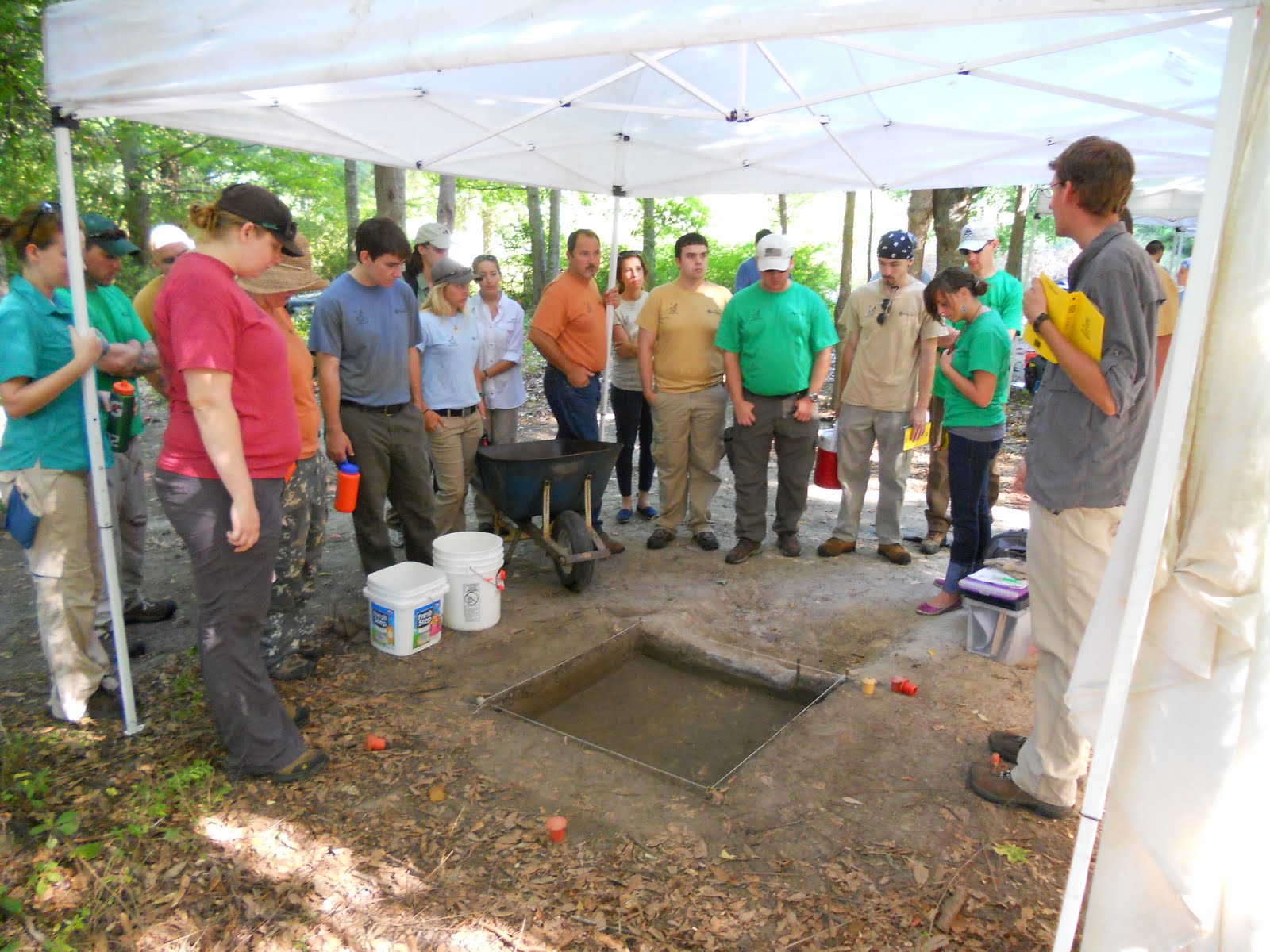
Students Brady Swilley, Rachael Mead, Sarah Bennet, Ashley Geisel, and John Hueffed look on as Patty McMahon explains the strategy for re-excavating an unfinished unit from the 2010 field season.


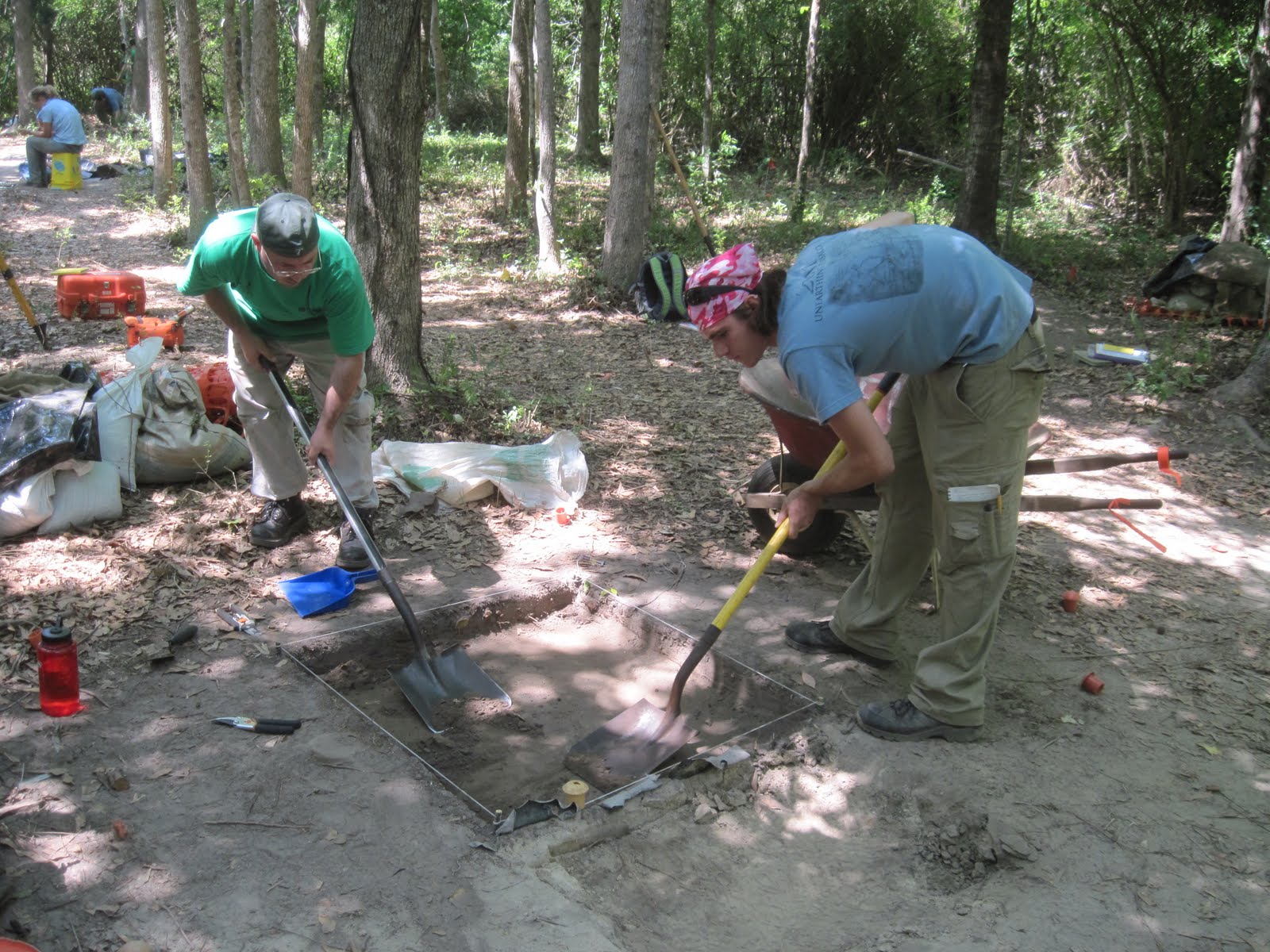
Students Jonathan Harpster, Marie Burrows, and Ralph Hosch beginning excavation in a new unit.


Field Director Danielle Dadiego explains mapping to students Nick Simpson and Ralph Hosch.


Colin Bean goes above and beyond, bending a tree out of the way of the total station.