Monday, June 6, 2011

Following leads

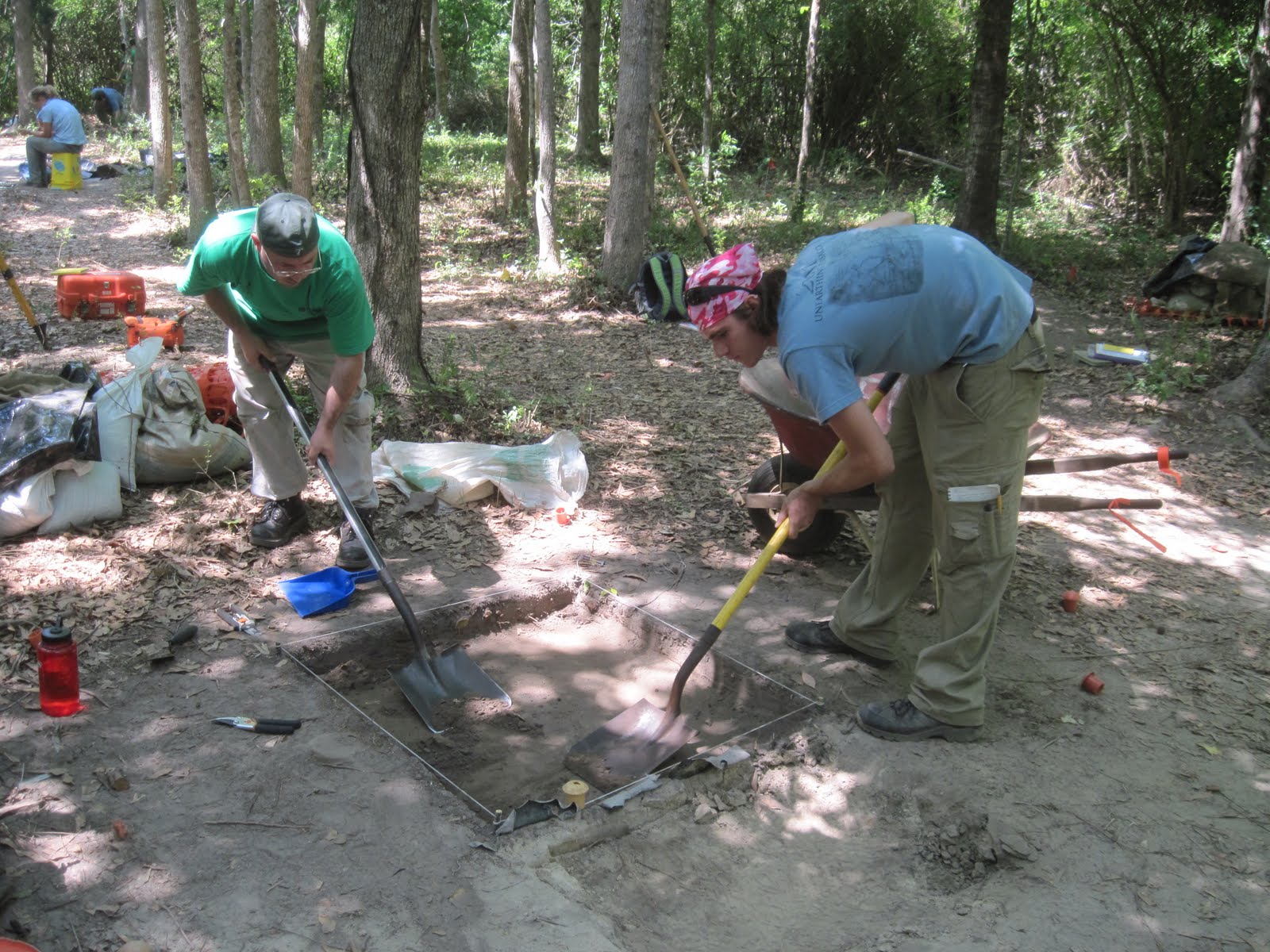
Despite high heat and humidity over the past few days, as well as a rainstorm last Friday which required bailing the units this morning, student crews are making solid progress in a number of excavation units, pushing downward in an effort to discover subsurface trenches and pits which will help us understand the layout and configuration of Mission Escambe's structures. One unit which may overlap a north-south trending wall trench filled with yellow clay produced a surprise in the form of an ash and charcoal-filled feature adjacent to the clay (above is Phillip Mayhair bisecting the feature). This feature may be the remains of a large (though shallow) burned post, or it may be a hearth or smudge pit, or something else entirely.

The long wall trench we have been following since 2009 seems to be coming to an end to the east, where there is as-yet no evidence of the trench continuing into our easternmost testpit. Careful exposure of the trench from the last unit it appeared in should allow us to delineate the probable corner, and will guide us in additional testing to determine the exact shape and size of what we presume to be the Spanish barracks (to right is Ralph Hosch excavating the feature eastward toward its likely terminus in the unit at the top of the picture).

To the west, a larger testpit opened south of the presumed western end of this wall trench has yet to encounter any evidence of the structure's western wall, so we will likely have to turn our attention northward to see if the corner discovered last year is the southwest corner instead of the northwest, as we had initially interpreted. With each bit of negative evidence, however, we narrow down our search for the clues to this large but maddeningly elusive colonial building.

Adjacent to this trench, a large (apparently) circular pit feature is carefully being excavated by levels into its dark, mottled fill (to left is Nick Simpson scraping the soil matrix around the feature on the left side of the unit). The pit seems to be getting narrower with depth, but it still dwarfs all other pits and postholes yet discovered at the site, so we are increasingly intrigued to learn its function. A large glass necklace bead was discovered in the matrix of this unit today (photo at bottom), probably providing further evidence of the Indian trade at this mission village.

To the south, we have also just opened a pair of units constituting a long slot trench we hope will expose the cross-section of as many as four mission-era wall trenches found just to the east in previous years. Unfortunately, this trench also falls between several fast-growing sweetgum trees, and the interwoven roots of these trees comprise a formidable barrier to the kind of slow, careful excavation we intend to conduct (photo to right). With the roots nearly all gone, we anticipate beginning to see evidence for mission-era structures soon.

Step by step, our 2011 summer field school team is following the leads that will provide at least some of the answers we seek at Mission Escambe this year.


Above, a large clear glass necklace bead, wire-wound and faceted, dating to ca. 1700-1800 and possibly made in Amsterdam but common on period Spanish colonial sites.

Wednesday, June 1, 2011

The return of the heat

With temperatures approaching 100 degrees today, students still continue to make progress in excavations at Mission Escambe. The brick-filled trench discovered last year has finally (and reluctantly) begun to yield up more definitive clues as to its age. Following careful excavation, photography, and the creation of a detailed scale map (pictured to left, drawn by Alesia Hoyle and Rachel Mead), the bricks are gradually being removed and cleaned in the field in order to determine whether any maker's marks are present which might help pin down a date for the feature. Finally, today, a large part of a brick appeared within the feature showing a portion of the familiar "J. GONZALEZ" name present on many of the bricks from the nearby late 19th-century sawmill's ruins (pictured below). This makes it very likely that the entire brick feature post-dates the 1830s (when the bricks began to be produced). We still have to confirm whether the deeper portion of the trench, with double rows of parallel nails marking some sort of wooden structure underneath, is also a 19th-century feature, or perhaps originally constructed during the mission period.

We are also continuing to trace the wall-trench structure we believe to be the cavalry barracks, though as yet we still have no unequivocal confirmation of either the west or east walls of the structure. Nevertheless, we have opened a new excavation unit over another pit feature that showed up in a corner of one of our 2010 units, just south of the wall trench, and this pit is now quite clearly defined as a rounded pit perhaps a meter in diameter (photo to right). With continued work we hope to discover whether this pit relates to some architectural feature or some other activity such as simple trash disposal. At another end of this wall trench, a large and partially-charred bone from a deer was uncovered (pictured below), providing additional evidence for foodways (and the deerskin trade) at the site.

We have also been pleased to welcome students from two other summer field schools in the past few days, including the UWF Forensic Anthropology Field School led by Dr. Joanne Curtin, as well as the UWF Campus Field School, led by Dr. Ramie Gougeon. Pictures from these visits, as well as other shots from the past few days, are shown below.


Above, Patty McMahon shows ongoing work to members of the UWF Forensic Anthropology Field School.


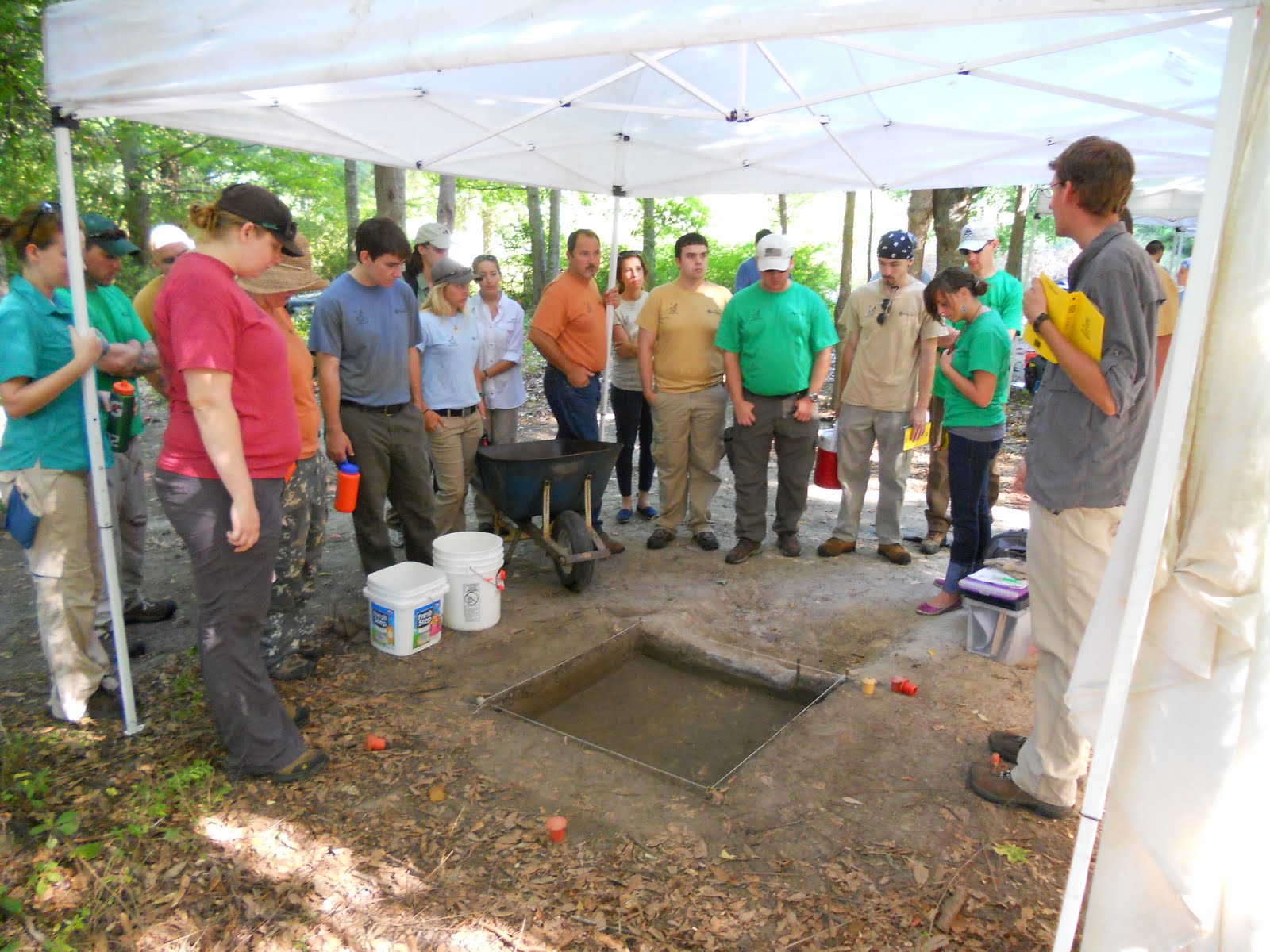
Students from the UWF Campus Field School listening to Colin Bean explaining current excavation strategies at the presumed barracks structure.


Patty McMahon photographs the profile of a bisected feature.


Two mendable sherds of Guadalajara Polychrome, a colonial Mexican ceramic type dating to the 18th century.

Thursday, May 26, 2011

Rain and more finds

Today we experienced our first rain of the field season at Molino, and packed in early. Nevertheless, the last couple of days have been productive in terms of progress toward our goal of defining the structures and activity areas at Mission Escambe. We are better defining the area encompassed by the gray clay floor (?) in the southern end of the site, and at the same time encountering what may be further evidence for earlier wall trenches filled with yellow clay (to left are Phillip Mayhair documenting a shovel test shaded by Danielle Dadiego, with Norma Harris to the right). We are also closing in on a possible corner of the presumed barracks structure that now extends for nearly 17 meters across the site, as well as another potential wall line and other features in this area. Students are also following another possible mission-era wall trench in the northern margin of the site (perhaps an Apalachee structure), while simultaneously discovering further evidence of prehistoric occupation at the site. Below are photos of some of the students at work, as well as some of our most recent finds providing further clues about past activities in various areas of the site.


Above, Ralph Hosch and Nick Simpson shovel-scrape the floor of an excavation unit.


Colin Bean keeps up with his field notebook, recording every detail about ongoing fieldwork in his area.


Rachael Mead and Alesia Hoyle carefully draw a scale map of the brick-lined trench feature.


A rimsherd of Puebla Blue on White majolica.


A sherd of Apalachee pottery, classified as Lamar Incised, variety Ocmulgee Fields.


A prehistoric check-stamped rimsherd, possibly Gulf Check Stamped, associated with the Santa Rosa-Swift Creek culture dating nearly 2 millenia ago.


Remnants of a handful of copper-alloy rivets discovered in one excavation unit, one of which has a molded star decoration on the head (the rest are plain). The function of these objects, and when they were made (during or after the mission period), is not yet known with certainty (suggestions are welcome!).

Tuesday, May 24, 2011

Great weather, steady progress

As we enter our second week of the 2011 field season, the weather continues to be clear, dry, and not too hot or humid (yet), and all our student teams are making great progress toward answering some of our most pressing questions about Mission Escambe. Each new excavation unit opened answers some questions, but normally raises others, and after two summers of fieldwork at the site, we have lots of questions!

Several excavation units have been opened along the known or expected track of Feature 10, a substantial post-on-sill wall trench we believe may be part of the 1760 cavalry barracks built at the mission. We have now confirmed that the trench extends for at least 15 meters from the corner we discovered last year (above, see Danielle Dadiego and Colin Bean studying the plan view of the trench, located in the left side of the open unit), and a new testpit is currently being excavated to the east to determine whether it continues in that direction. Another excavation unit has been opened due south of the corner discovered last year, and there are preliminary signs that we may be coming down on the western wall of the barracks structure in this unit as well. The military barracks located in San Miguel de Panzacola at the same time (1760s) were no shorter than about 17.5 meters, and housed substantially more soldiers, so we anticipate finding another corner very soon.

In another area, students are excavating along the course of a brick-filled trench discovered last year to the north of the barracks (to right are John Hueffed and Rachael Mead excavating on either side of the exposed bricks). So far, all the bricks in this trench appear to be handmade and distinct from those found in nearby sawmill ruins known to date to the late 19th century, but as yet we are uncertain as to the date of this feature. Analysis of last year's excavations suggest the trench may include fragments of 19th-century bricks, but we hope to clarify this situation in 2011.

To the south, shallow shovel tests have been opened in the area of a widespread gray clay layer that was identified last year capping yellow clay fill within post-in-trench wall trenches from no fewer than three overlapping mission-era structures. We have already discovered what appears to be the eastern limit of this gray layer (left are Phillip Mayhair and Michelle Pigott mapping two of these tests), but units to the north still show evidence of the clay, and southern and western tests have yet to be started. The soil in this area is very dry (as it is across the rest of the site), making it a challenging task to probe this layer and discern color changes while excavating.

Among the more common residential debris from the mission site such as Apalachee Indian pottery fragments, rusted nails, etc., students discovered the drawn white tubular glass bead below, as well as a well-preserved large wrought iron nail or spike (unrusted where fire must have tempered the iron), and a lead musketball (approximately 59 caliber; clipped by the shovel), all shown below:


Tubular glass bead.


Large wrought iron nail, partially unrusted.


Lead musketball, approximately 15 mm. in diameter.

Thursday, May 19, 2011

We're back...2011 field season begins!

The 2011 University of West Florida Colonial Frontiers field school is now underway, and we're pleased to inaugurate a new series of entries to our annual project blog. With a team of 14 students enrolled in the undergraduate section, 3 graduate student supervisors, and graduate student field director Danielle Dadiego, along with principal investigators John Worth and Norma Harris, we have successfully re-cleared the 2010 excavation area from all the growth that had sprouted since last year, re-established our mapping grid, and laid in and begun excavating five new excavation units as of Wednesday of our first week. Our goals for this summer include finally tracing out the complete outline of the large post-on-sill wall-trench structure which we have been following for two seasons (and which we suspect is the 1760 cavalry barracks), exploring the architectural features associated with at least three overlapping post-in-trench wall-trench structures under multiple clay caps just south of the possible barracks structure (this area may be the convento and/or church area of the mission), and continuing to explore the possible Apalachee residential area which produced multiple posts and smudge pits dating to the mission period last year, and which contains an as-yet undefined brick-filled trench feature that we hope to clarify this year. More details will follow in subsequent posts, but the images below will give a general sense of our work at the site so far.


Above, supervisors Patty McMahon, Lindsey Cochran, and Colin Bean work on setting up the total station for mapping, with Norma Harris looking on.


Students Alesia Hoyle, Michelle Pigott, Phillip Mayhair, and Joe Stevenson learning total station procedures from Lindsey Cochran.


Marie Burrows and Katie Brewer lay out an excavation unit with Colin Bean looking on.


Students Brady Swilley, Rachael Mead, Sarah Bennet, Ashley Geisel, and John Hueffed look on as Patty McMahon explains the strategy for re-excavating an unfinished unit from the 2010 field season.


Students Jonathan Harpster, Marie Burrows, and Ralph Hosch beginning excavation in a new unit.


Field Director Danielle Dadiego explains mapping to students Nick Simpson and Ralph Hosch.


Colin Bean goes above and beyond, bending a tree out of the way of the total station.

Monday, July 26, 2010

More documentation and backfilling

Staff and student volunteers returned to Molino today to finish documenting profiles in two remaining excavation units, followed by a last push to backfill these units. Once profiles had been carefully mapped and colors recorded (pictured at right are Sarah Everhart, John Krebs, Rachel DeVan, and Jennifer Melcher), the two remaining large units were completely backfilled, leaving only a single remaining shovel test to be documented later this week. The backfilling began with shovels and wheelbarrows, as on previous days, but toward the end of the day we were generously aided by Mr. Richard Marlow, who made many trips back and forth to deliver fill dirt for the last remaining excavation block using his tractor. The video below shows part of that operation, which was a real lifesaver for our already-exhausted students. Thanks again, Mr. Marlow....we couldn't have finished up without you!


The units we backfilled on Friday were subjected to considerable rain over the weekend, but barely settled at all, leaving the level surface we were hoping for (see picture below). Although some units will have to be re-excavated next year for continued exploration in these areas (in some cases for the third time), in the meantime the vegetation and leaf litter will cover virtually all traces of our excavations over the course of the next year.

Saturday, July 24, 2010

Completing the 2010 Colonial Frontiers field school

On Friday, students finished excavation and documentation of all but three remaining units, and backfilled the rest on our final day of the 2010 field school at Molino (pictured at right is Sara Smiddie returning for another wheelbarrow load of dirt). Field conditions during our final days were extremely hot and muggy, but in the end it was an approaching afternoon thunderstorm that ran our crew out a bit earlier than expected.

The 2010 field season was a resounding success on several fronts. While in the end we probably found more questions than answers, and more complexity than clarity, we nonetheless made great progress in understanding the Escambe mission site overall, and obtained a much broader view of the structures we encountered last year.

One of the more intriguing features discovered last year was the substantial post-on-sill wall-trench we believe to have been part of the Spanish cavalry barracks documented to have been built during the summer of 1760 under the direction of engineer Phelipe Feringan Cortés. As can be seen in the mosaic image below showing the largest contiguous section in this area (south is to top), we opened broad areas of this trench during the 2010 season, extending over a total of more than 12 1/2 meters of the trench's original length.

Friday, on our very last day, we were thrilled to confirm that the westernmost end of this trench had finally been encountered, and that we had indeed discovered the northwest corner of this building (pictured at right is graduate supervisor John Krebs reveling in the moment). The east-west trench apparently terminates and turns south (to the left in the picture below), while a substantial wooden buttress post extends just northward from the corner, within which nearly a dozen nails were discovered, presumably anchoring the post (see rectangular patch of light-colored clay just right of the wall-trench corner in the lower left corner of the picture). Based on the discovery of this corner, as well as the extent of the wall-trench running due east from this point, we now know that the presumed barracks structure was at least 12 1/2 meters east-to-west, amounting to some 15 Spanish colonial varas. This was clearly a substantial structure, despite the fact that the cavalry garrison of 15 men was located in such a small, remote mission village.

To the south, excavations in the area of three overlapping post-in-trench wall-trenches produced a remarkable 6-meter-long profile showing the trenches and associated dark midden deposits, as well as at least two episodes of clay capping (in the photo mosaic below see deeper yellow clay layers underlying the lighter gray-pink clay just below the surface). This profile provides crucial details augmenting what we have already discovered about the shape and configuration of the three successive structures built in this location, though much more work remains to be done in order to trace out the walls and discover the overall size and function of the structures. The artifact assemblage discovered in this area of the site is somewhat distinctive, including not just a wide range of non-aboriginal goods such as Spanish cookware and tableware, Oriental porcelain, a folding razor, and abundant lead shot, but also a considerable proportion of red-filmed aboriginal pottery (presumably made by Apalachee potters) and other ceramic types. This excavation block in particular has become more complex over the course of our summer work, and we won't expect to get any definitive answers until additional fieldwork is carried out next year.

Among the noteworthy finds from our last days include a sherd of prehistoric shell-tempered pottery with an adorno loop handle (pictured to right), discovered in the remaining northern excavation block which has already produced considerable evidence for prehistoric occupation at the site. Documentation of this block will have to wait until early next week, when we plan to finish up what remains and backfill the open units using staff and supervisors, along with student volunteers.

Another discovery was the second ground stone discoidal found at the site, made from fine-grained red sandstone and ground into a small disc, possibly used for gaming. Though this example is considerably smaller than a greenstone discoidal discovered last year, it was still an exciting find (pictured below is finder Cody Poitevint holding the disc). Whether or not it was made and used during the mission period, or instead during prehistoric occupation at the same site (or even found and re-used during the mission period), it nonetheless provides evidence of stonework using extralocal material.

Though we will post additional blog entries following additional wrap-up work next week, at this time we would like to express our considerable thanks to Mr. Richard Marlow and his family for their hospitality and support throughout our field season. Continuing research at Mission Escambe would not have been possible without their interest and help. We are also grateful to Boyett's Septic Tank & Vacuum Pumping for the generous donation of the use of a portable toilet and sink throughout the 2010 field school, for the second year in a row. The Pensacola Colonial Frontiers project is sponsored by the Archaeology Institute and Department of Anthropology at the University of West Florida. We would also like to acknowledge the help and interest of a number of volunteers and visitors, including but not limited to Wayne Abrahamson, Neal Collier, Dave Dodson, Sarah Everhart, Nick Honerkamp, Sarah Mitchell, Debbie Mullins, Aubrey Palmer, Harold Pope, and Amanda Salazar Clonts.