Sunday, June 7, 2015

Three weeks down

Crew lunch sitting around the location of the hearth found in 2014.
Three weeks into our 2015 summer field school season, the PCF crew is making good progress in both the mission and sawmill areas of the site.  On the terrace summit, excavations continue in two 1x2m units along the the possible wall-lines of the circular structure predicted to surround the burned clay hearth discovered last year (and around which our entire field crew had lunch this past week, sitting within what would have been the walls of this presumptive Apalachee structure; pictured above).

The southern unit intersected the clay-capped trenches we now believe resulted from an early 19th-century log skid road, and these features are currently being excavated to allow progress in the underlying and adjacent undisturbed mission-era midden and possible wall line (pictured below). Mission-era artifacts are still being produced in this unit (possible pipe bowl rim pictured below), with more doubtless to come once the later features are removed.

Emma and Tyler carefully removing the yellow clay from the underlying trench fill.


Tyler holding a possible pipe bowl or tiny bowl fragment.
Sabrina bisecting the shallow postmold.
The eastern unit has already produced a small, shallow post feature that may relate to benches or walls within the structure (pictured while being bisected, to left), as well as quite a bit of residential debris from the mission period, including abundant Apalachee ceramics, gunflint flakes, and a good number of small fragments of Spanish majolica dishes (pictured below).

Several tiny sherds of majolica, one with orange and brown paint under the glaze.


Jodi and Darby working on all four unit profiles.
The unit in Area C to the south that had been begun in 2014 was finally completed and backfilled this week, and detailed profiling of the stratigraphy and the clay-lined feature disturbance in it will help us interpret this unit in light of the line of three deep posts found just to the northwest in an adjacent unit last year (which we plan to explore next in this area).
All four profiles lined up together showing corresponding strata.


To the east below the bluff edge, three excavations in Area F are probing the layout of the late 19th-century sawmill here. On the bluff slope, a 1x2m unit is still being lowered to the elevation of a brick floor discovered last year in a nearby shovel test.  This flooring structure seems to have been covered in accumulated soil from higher up the slope, and while most of the overlying artifacts date to the mill period, some earlier material also appears in these deposits, presumably having washed in from above.
Jillian and Caroline excavate around several concreted mill-era iron objects.

The nearby shovel test at the base of the bluff has dropped right on top of the edge of what initially appears to be some sort of clay floor or wall foundation, which is adjacent to (and partially mixed with) a rubble deposit with large broken bricks and brick fragments and other debris mixed with dirt.  The explanation for these finds is still unknown, but continued excavation in this shovel test should provide important clues.
View of brick rubble adjacent the clay feature in the shovel test (facing east).

Farther east, a new 1x2m unit was just opened on Friday out in the middle of the sawmill structure on the shaded lower terrace, and also in the middle of the worst infestation of mosquitoes at the site.  Roots are plentiful in this unit, including huge masses of greenbrier roots, such as the gargantuan one pictured below.  Probing suggests there should be another brick floor in this area, and we have hopes that debris from the 1884 fire that destroyed Molino Mills might show up in this area, permitting us to learn more about the spatial layout of the mill and its machinery and work spaces.
Michelle Pigott and Jen Knutson triumph over a greenbrier root; Kelsey and Melissa in background.


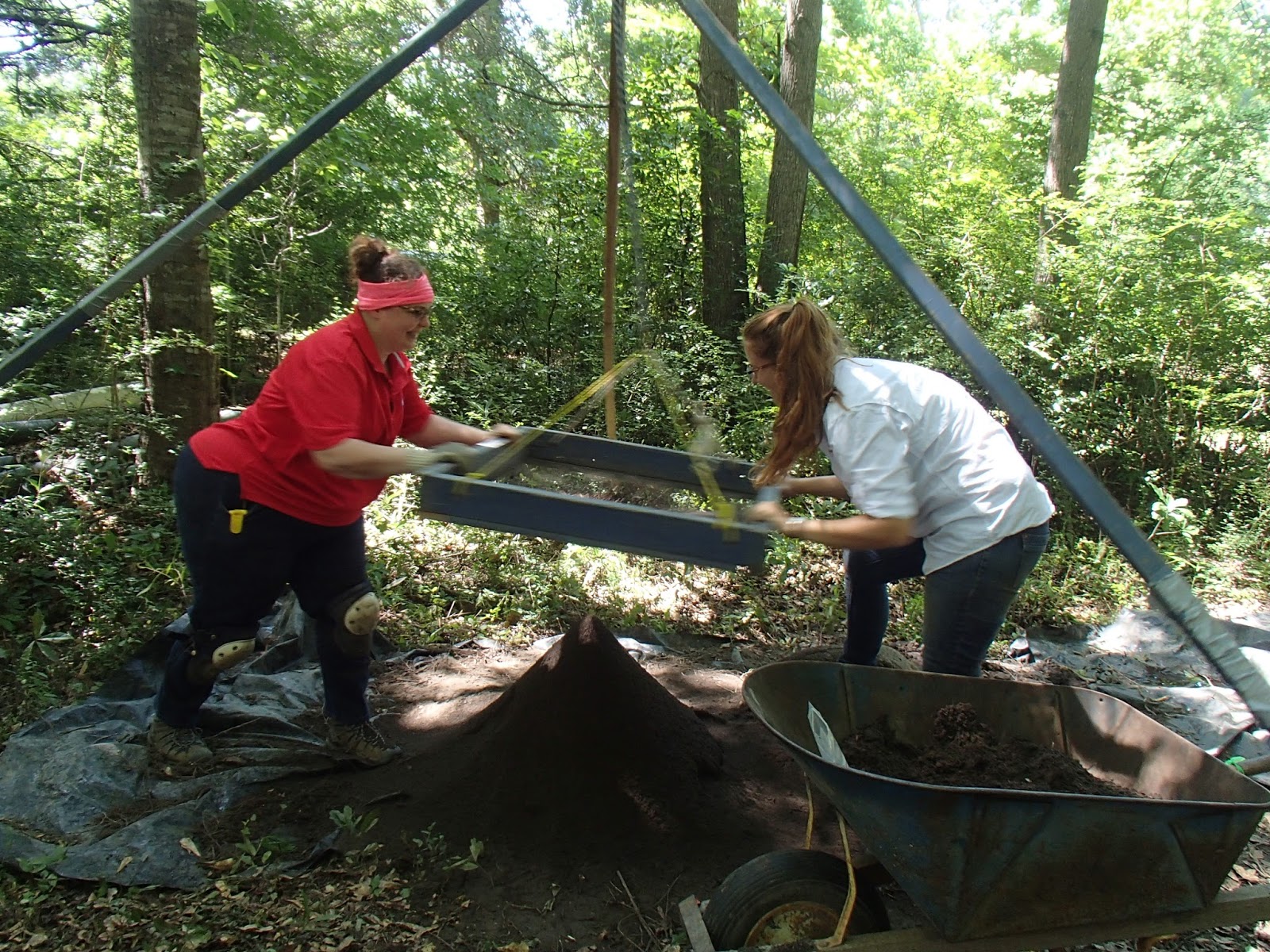
In addition, we finally have our waterscreening station operational now (pictured below), allowing our crew to make better progress through the sometimes-dense clay deposits at the site.
Waterscreening with Darby, Caroline, Tyler, Sabrina, and Jillian.


A few pictures follow of some of the animal residents of the site, including our self-appointed field dog, "Precious" aka "Diggity Dog."
A green tree frog perching perilously close to some huge thorns.

A tussock moth caterpillar crawling on Emma.

Our near constant field companion, "Precious" (or "Diggity Dog"); Tyler, Darby, and Kayla in background.


Sunday, May 31, 2015

Progress despite the rains

Kelsey Bruno holds an iron implement she just excavated.
Two weeks into our 2015 field school, our crew continues to make steady progress, despite a number of delays and missed time due to rainy weather and saturated ground, along with the normal startup difficulties in getting our total station and new datums fully aligned with the existing site grid.  One excavation located along the bluff slope has been effectively halted due to soggy ground, but a nearby shovel test at the foot of the bluff on the surface of the lower terrace has already begun to produce evidence of the sawmill that burned down here in 1884, including an iron tool or machine part (pictured above) and a possible corner brace, along with brick fragments.  This shovel test should drop to the presumed floor level of the sawmill within a level or two, where previous probing with a steel rod suggests there may be a brick floor or other structural evidence.

Additional evidence for mill-era activity on the summit of the terrace where the mission had been located is also abundant as in previous years, including near-surface scatters of brick fragments, slag, charcoal, iron nails and other fragments, and late 19th-century glass and ceramics.
Notable finds this week include a heavy iron object that may be a tool or machine component (pictured to left), a distinctive brass fitting from an as-yet unidentified object or implement, and an intact cobalt blue Bromo-Seltzer bottle that appears to date between 1891 and 1907 (the latter two pictured below).

Bromo-Seltzer medicine bottle made in Baltimore between 1891-1907.

Brass fitting or fastener with decorative design on one side.


Three 1x2 m excavation units in the mission area of the terrace summit made good progress this week, including one unit that was begun in 2014 and will be finished this year with the excavation of its base into sterile clay subsoil beneath an unusual clay-lined pit feature that appears to date to the sawmill period, but which falls in line with a series of three posts just to the west that we believe might be a mission-era structure wall, perhaps even the long sought-after church.  Ongoing excavations in two units to the north have been laid in along the predicted southern and eastern wall lines of a possible Apalachee circular residential structure with a clay floor and hearth feature found last year (along with a possible roof-support post nearby).  These units are both capped to some extent by what now appear to be post-mission-era clay deposits, one of which is currently theorized to have been a logging skidway with two parallel trenches and evenly-spaced trenches traversing it, resulting from the placement of round logs in the ground to assist in the dragging of felled trees across the ground to the sawmill (perhaps the early 19th-century sawmill operated at some distance west by Thomas Cooper).  When the skid road was replaced by a short railroad line in the Reconstruction era, the logs seem to have been removed and the entire roadway covered with a layer of hard yellow clay to fill in the trenches.  Later, another layer of mottled gray clay was also deposited over and around the roadway in this vicinity, and the amount of charcoal, slag, coal, and small brick fragments here might possibly represent the location of the blacksmith's shop documented for Molino Mills, or it could also be associated with the railroad engine that transported wood to the main rail line to the east.  Pictures of these clay deposits are below.

Emma Dietrich excavates the northern edge of the yellow clay that intrudes on mission deposits here.

Clear stratigraphic relationship between dark modern humus, mottled gray clay below, and brown mission-era midden deposit below that.


Underneath these clay deposits are the intact 18th-century midden deposit associated with the possible Apalachee structure.  Students found several rimsherds of Mission Red pottery in one of these units this week, as well as an intact but battered small honey-colored chert gunflint (all pictured below).  Within a few days we hope to begin seeing whether there are postholes extending below this midden representing the predicted wall line of the Apalachee structure surrounding the hearth found last year.

"French-style" gunflint, probably pistol sized.

Rounded rimsherd of a Mission Red vessel, painted on both sides.

Flattened rimsherd of a different Mission Red vessel, also red on both sides.


Below are additional photos of fieldwork since our last blog update.  Stay tuned for more as we make further progress in Week 3.

Olivia shovel-shaves the midden at the floor of her level.

Darby works on cleaning up the base of the unit begun in 2014.

Jodi and Emma team up to sift.

Darby holds the stadia rod to take elevations; Jodi in background.

Tyler shovel-shaves sawmill-era deposits in her unit.

Kayla works to square up the base and walls of her shovel test at the base of the bluff.

Tuesday, May 19, 2015

First Day Back

Our full 2015 PCF field school crew (and field-dog-of-the-day)
The summer field school season began to day at Molino, with a full crew, and lots of energy and enthusiasm, only mildly tempered by the claustrophobia-inducing swarms of hungry mosquitoes and early summer heat.  Joined by undergraduate students Kelsey Bruno, Sabrina Cummings, Darby Gorin, and Tyler Huggins, the full crew (pictured above) quickly set to finalizing our first three 1x2 meter excavation units, two positioned at the predicted outer walls of a possible circular 18th-century Apalachee residential structure surrounding a probable central hearth discovered last year, and another along the edge of a buried brick floor also found last year below the terrace in association with the 19th-century sawmill next to the mission site.  Students also got a start at re-excavating a backfilled unit-in-progress along the possible wall of a large structure that might be the long sought-after mission church, and a shovel test was staked in at the bluff base along the edge of the mill as well.

The day began with instruction and training sessions ranging from field note-taking to trowel-sharpening, and flat-shoveling to proper dirt-throwing, and our sights quickly turned to hammering in the final re-bar corner posts for our new units using triangulation in combination with our occasionally finicky total station laser transit.  Sandbags were filled using backfill from last year, and paperwork and bags were begun, and while only one unit actually broke ground by the end of the day, we count today as a successful start to our 2015 field season.  Pictures from today's work follow below.

Darby and Tyler practice sharpening their trowels.

Kayla focuses on balancing the total station prism.

Darby and Kelsey stake in a unit corner; also pictured are Emma, Sabrina, Tyler, and Jen.

Tyler and Kelsey string in a new unit.

Sabrina gets shovel-tossing right; also pictured, Tyler.

Kelsey nails shovel-tossing; Jodi also pictured.

Caroline and Sabrina get paperwork started for their new unit.

Darby puts the first dirt of the season in the screen for Olivia to sift; also pictured, Jen.


Friday, May 15, 2015

2015 Colonial Frontiers Field School Preparations

(L-R) Jen, Kayla, Jodi, Emily, Melissa, Caroline, Olivia, and Jillian
The stage is now set for the sixth Pensacola Colonial Frontiers archaeological field school, once again focusing on the mid-18th-century Mission San Joseph de Escambe, but this year including expanded fieldwork at the adjacent Reconstruction-era Molino Mills steam-powered sawmill (1866-1884), along with new shovel testing at a Second Spanish-era water-powered sawmill site farther south along the Escambia River, both of which are the respective thesis projects of this year's graduate field directors-in-training Melissa Maynard and Jillian Okray (pictured above).  Our supervisory crew also includes four additional returning members of last year's crew, graduate student site supervisor Jen Knutson, graduate student supervisors-in-training Olivia Pitts and Jodi Preston, and recently-graduated Kayla Rowe, along with two newcomers to the PCF field school, graduate student supervisors-in-training Emily Dietrich and Caroline Peacock. Dr. John Worth will once again serve as principal investigator.

This week the supervisory crew prepared equipment and paperwork for the field school starting next week, and made several visits to the site, including half a day today (Friday), clearing brush, raking excavation areas, re-establishing the site mapping grid (with the much-appreciated help of UWF Archaeology Institute research associate Jennifer Melcher, also a veteran of the first two field seasons at the mission), and staking in new excavation units.  While details will follow over the course of the next ten weeks of fieldwork, the pictures below show some of the activity from this week.

Melissa probes the lateral extent of a buried sawmill-era brick floor discovered last year.

Jennifer Melcher runs a training session on total station use; also pictured are Jodi, Olivia, Kayla, Caroline, and Emily.

Caroline holding the stadia rod for mapping.


Kayla makes good use of a machete.

Olivia after delivering more brush to the brush pile.

Staking in an excavation unit; (L-R) Jen K., Jillian, Jen M., Olivia, Jodi.

One of the mission's reptilian denizens, the Gulf Hammock Rat Snake (Elaphe obsoleta williamsi), climbing a tree.

In a curiously familiar moment, Dr. Worth tries to make friends with the snake.

Friday, October 3, 2014

Field School Wrapup and Beyond

A group picture of our crew at the end of the 2014 field school.
The 2014 Pensacola Colonial Frontiers field school at Mission Escambe is now history, but work continues on our finds from the summer.  In addition to posting a few shots of our intrepid crew during the final week of fieldwork and backfilling at the end of July (below), this post details recent work on the small Apalachee jar that was excavated at the site in July.

Dr. Worth carefully positions the jar with dirt still inside.
The fractured vessel was removed whole, with all the original sediment within it still adhering to the vessel fragments on the outside.  In September, the jar was x-rayed in the UWF archaeological conservation lab, providing for the first time a glimpse of the walls of the jar, which were clearly somewhat less complete than we had originally believed in the field.  Nonetheless, the partial vessel had been discarded facing down in a pit excavated for a posthole, thus providing an unusually enclosed and protected environment for the interior of the pot, and the midden sediments that eventually settled there after burial.  For this reason, the final excavation of these sediments, and the separation of the vessel fragments from the cast of the interior of the vessel, was done in such a way as to maximize the possibility for residue and sediment testing, a project currently being pursued by graduate student Jen Knutsen.

Michelle and Jen watch Dr. Bratten as the image is captured.
 The pictures on this blog post detail both the x-ray process and the cleaning of the jar, leading to the exposure and cleaning of all the large fragments that had originally been deposited together in the partially-intact vessel.  We will update the progress on this and other labwork through the year as we continue to try and learn more about the residents of Mission Escambe following five field seasons of archaeological work there, for which we continue to be grateful to Richard Marlow and his family for their hospitality and welcome.

Dr. Bratten observing one of the full x-ray images of the jar.
An x-ray of the still-assembled jar and sediments within, showing the vessel profile clearly.


Michelle carefully cleans the dirt adhering to the vessel fragments.

One of the larger basal fragments comes free from the dirt inside.

Jen continues cleaning the dirt, catching the contents in a bowl for later analysis.

A large fragment of the upper shoulder and flaring rim of the jar.
Cleaned fragments of the small brushed jar.
 The pictures below were taken during our final week in the field during late July.
 
The trench in Area E half-filled with backdirt (and lined with landscape cloth).
Chelsea pours backdirt into a completed unit in Area G.

Mr. Marlow uses a tractor and front end loader to dump backdirt right in the wheelbarrows.